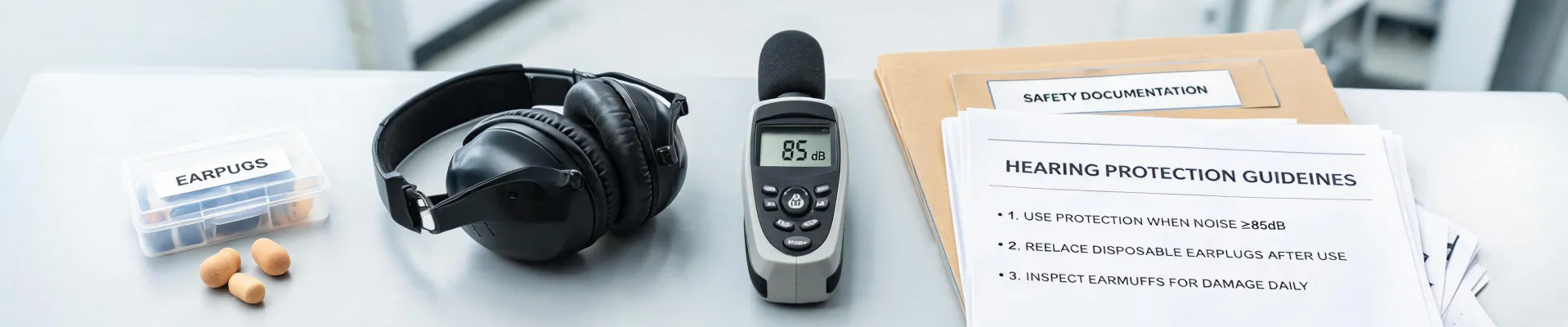
You Need Two Different Solutions for Hearing Protection, Not One
Here's the conclusion you can take to your safety committee: If you need maximum passive noise reduction, get the Howard Leight Max foam earplugs (NRR 33). If you need situational awareness and communication with protection, get the Howard Leight Impact Sport Bluetooth earmuffs.
That's it. Trying to find a single product that does both equally well usually ends in compromise. In my experience reviewing specs and handling returns for our facility, the 'do-it-all' approach to hearing protection is where most procurement mistakes happen.
From my perspective, investing in both product types—and training staff on when to use which—has reduced our workplace noise complaints and improved compliance in our quarterly audits.
Why You Should Trust This Breakdown
I'm a quality and compliance manager at an industrial supply distributor. I review roughly 200+ unique PPE items each year before they reach our customers. In Q2 of 2024, I rejected 12% of our first-round deliveries from a major earplug supplier because the foam expansion rate was inconsistent—a subtle issue that affects fit and actual protection. The vendor claimed it was 'within industry standard,' but our in-house testing showed otherwise. We rejected the batch, and they redid it at their cost.
In my experience, NRR ratings on a box are only part of the story. Real-world attenuation depends on fit, wear time, and user behavior. That's why I focus on products with a track record of consistency and why I lean on Howard Leight for core hearing protection.
Unpacking the Two Core Products
Howard Leight Max Foam Earplugs (NRR 33)
These are our benchmark for passive hearing protection. The NRR 33 rating is the highest common rating in the industry. That's not just a number on a package; it means in a lab setting, they reduce noise exposure by 33 decibels when fit correctly. The real-world derating (which OSHA and NIOSH recommend) brings it closer to 22 dB, which is still substantial.
When I compared our Q1 results using a generic foam plug (NRR 29) and the Max (NRR 33) side by side—with proper fit testing—the Max consistently provided a better seal across a wider range of ear canal sizes. The slower-recovery foam is the key. It's not a gimmick. It gives the user time to roll and insert the plug properly.
It's tempting to think all foam earplugs are the same. They are not. The 'just buy the cheapest NRR 33 plug' advice ignores the fact that the foam density and expansion rate affect user comfort and long-term wear compliance. A cheaper plug that users remove after 30 minutes due to discomfort is a safety failure, not a cost saving.
Howard Leight Impact Sport Bluetooth Earband
This is a different category entirely. It's not for the blast furnace floor. It's for environments where noise levels are intermittent or where a user needs to hear machine warnings, listen to a supervisor, or take a call while wearing protection. The 'Impact' feature cuts out dangerous impulse noises (like a hammer strike) but amplifies ambient sound. The Bluetooth variant adds the ability to take calls or listen to audio (where permitted by safety policy).
Worse than expected: A few users on our plant floor tried using them in a continuous 95 dB environment and found them inadequate. That's not a product flaw—that's a use-case mismatch. These are rated for moderate noise, not extreme, continuous exposure. The vendor who told me 'this isn't our strength—here's who does it better' earned my trust for everything else. This product is a specialist, not a universal solution.
Boundary Conditions: When These Aren't the Right Choice
No product is perfect for every situation. Here's the honest assessment:
- Max Earplugs (NRR 33) are not ideal for: Users who cannot achieve a consistent fit (common with very small or very large ear canals). In those cases, a custom-molded plug or a high-NRR earmuff like the Howard Leight Leightning is better. Also, don't use them in areas where you need to hear warnings—they block too much steady noise.
- Impact Sport Bluetooth are not for: Continuous noise above roughly 95 dB. The electronics can't keep up with the level of noise reduction needed. For heavy industrial noise, you need a dedicated electronic earmuff with higher rated protection.
- General advice: If you're mixing tasks—e.g., a worker goes from a quiet assembly area to a noisy machine area—a dual-protection strategy (plugs and muffs) may be required. A single product won't work for both extremes.
I'd rather work with a specialist who knows their limits than a generalist who overpromises. The Max earplugs and Impact Sport earmuffs are exactly that: specialists. They excel in specific, well-defined jobs. Using them outside those boundaries is not a product failure—it's a specification failure. And that's on the buyer, not the brand.

Maeve Callahan
Maeve Callahan is a head-protection analyst covering Type I and Type II hard hats, climbing-style safety helmets, bump caps, chin straps, suspensions, liners, and face-shield carriers. She applies ANSI Z89.1, EN 397, and EN 12492 criteria while comparing impact attenuation, penetration resistance, lateral deformation, electrical class, retention strength, field of vision, mass, fit range, and temperature conditioning. Her guides help EHS teams, contractors, utilities, and buyers select helmet systems for overhead hazards, work at height, electrical exposure, accessory compatibility, and worker acceptance.