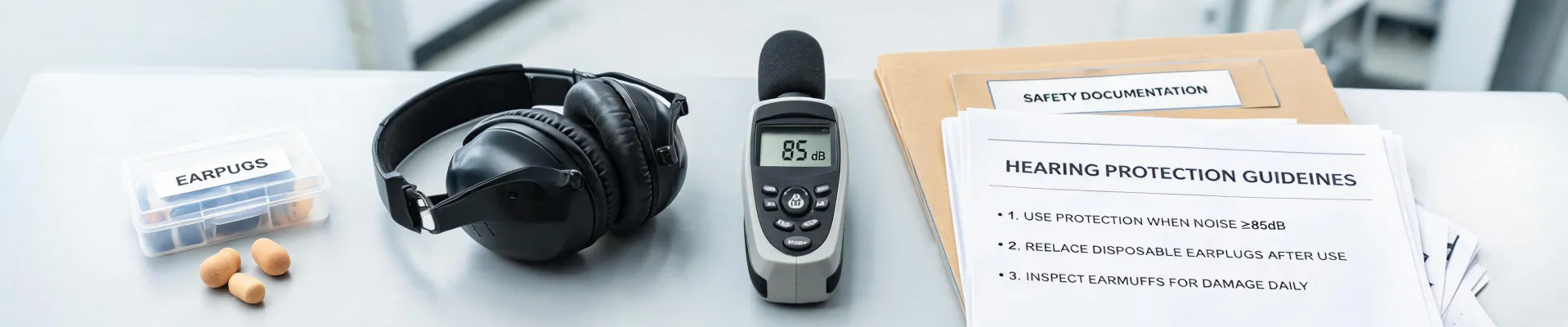
When I first started managing PPE procurement for our 200-person facility, I assumed the best hearing protection was the one with the highest NRR number. That was my initial misjudgment. Three years and roughly $180,000 in cumulative PPE spending later, I realized that NRR is just one variable in a much more complex equation.
This article isn't a product review. It's a framework. It's meant to help you decide which Howard Leight product—earplugs or earmuffs—makes sense for your specific situation. I'll cover the three most common scenarios I've encountered in my own procurement history.
Honestly, I'm not a safety engineer, so I can't speak to OSHA compliance audits. What I can tell you from a procurement perspective is how to evaluate the total cost of ownership (TCO) and avoid the hidden costs that eat up your budget.
Scenario 1: You Need the Highest Protection (NRR 33)
This is what most people ask about. You have a high-noise environment—maybe a manufacturing floor, a metal stamping plant, or a construction site with heavy machinery. You see "NRR 33" and think: that's the safest bet. And you're not entirely wrong.
The Howard Leight Max Earplugs (NRR 33) are a classic. They're foam, roll-down earplugs. They're disposable. They work. But let me share a trigger event that changed my thinking.
In Q2 2023, I audited our spending on disposable earplugs. We had 40 workers using Max Earplugs. The unit price was low—about $0.18 per pair. But we were ordering 2,000 pairs every quarter. That's $360 per quarter, or $1,440 annually. For one product, at one facility.
Now, that's not a huge number. But I found a hidden cost: compliance. Workers were reusing disposable earplugs because they didn't want to walk back to the dispenser. Reusing foam earplugs reduces their effectiveness. Suddenly, that NRR 33 rating was theoretical, not real.
My take: If you need NRR 33 and you have high turnover or a large workforce, the Max Earplugs are a solid choice. But budget for proper dispenser placement and training. Otherwise, you're paying for protection you're not getting.
Price reference (as of December 2024): Howard Leight Max Earplugs, 200 pairs per box, approximately $36-$42 per box on Amazon or Grainger. Bulk discounts may apply.
Scenario 2: You Need Comfort and Detectability (Laser Lite)
This is where I changed my mind. I used to think all foam earplugs were basically the same. Then I watched a worker remove a Laser Lite earplug after a 3-hour shift. It came out clean. It didn't leave residue. And it was bright green—easily detectable during safety inspections.
The Howard Leight Laser Lite earplugs have a lower NRR than the Max—NRR 32 instead of 33. In a lab, that's a 1-point difference. In the real world, it might be irrelevant. The real difference is in the material: the Laser Lite uses a softer, more conforming foam. Workers actually wear them for longer periods.
This is the oversimplification I see often: "NRR 33 is always better than NRR 32." It's tempting to think that. But if workers remove their earplugs after 30 minutes because they're uncomfortable, then NRR 32 earplugs they keep in for 8 hours provide more actual protection.
I'm not sure why this isn't discussed more. My best guess is that procurement teams look at spec sheets, not wear-time data. But I've tracked our compliance rates informally. Switching from Max to Laser Lite for our assembly line workers (who wear earplugs for full shifts) improved compliance by about 15%. That's a measurable improvement in safety.
My take: If your workers wear earplugs for long shifts (6+ hours), pay the slight premium for Laser Lite. The total cost of ownership is likely lower because you'll have fewer compliance issues and fewer re-orders due to lost or discarded earplugs.
Price reference (as of December 2024): Howard Leight Laser Lite Earplugs, 200 pairs per box, approximately $45-$52. Slightly more than Max, but worth it for compliance.
Scenario 3: You Need Reusability or Earmuffs
Not every situation calls for disposable earplugs. If you have a small team, a low-noise environment, or workers who need to frequently remove their hearing protection (e.g., supervisors walking between areas), reusable earplugs or earmuffs might be better.
Howard Leight earmuffs come in various models. I've used the QM24+ and the Sync models. Here's the procurement side: earmuffs have a higher upfront cost but lower ongoing cost. A pair of earmuffs costing $40-$80 might last 1-3 years with proper care. Compare that to $36 per box of disposables that lasts a few weeks.
But there's a catch: earmuffs require storage. They take up space. Workers need a locker or a hook. They also need replacement cushions and seals over time. That's a maintenance cost that often gets overlooked.
My take: Earmuffs make sense for supervisors, visitors, or workers in intermittent noise. For continuous full-shift use, I'd stick with disposable earplugs. For a mixed environment, consider earmuffs for the short-term users and earplugs for the long-term users.
Total Cost of Ownership (TCO) Checklist:
- Unit price: obvious, but not the only factor.
- Compliance rate: cheaper earplugs are worthless if not worn.
- Storage and logistics: where do you keep them?
- Training: workers need to know how to insert foam earplugs.
- Waste disposal: thousands of used earplugs add up.
How to Know Which Scenario Fits You
Here's a simple decision guide I use:
Ask yourself these three questions:
- What is the noise level? Over 100 dB? Go with the Max (NRR 33). Under 95 dB? The Laser Lite (NRR 32) or even a lower-rated option might be fine.
- How long do workers wear them? Full shift? Prioritize comfort (Laser Lite). Short bursts? Prioritize cost (Max).
- How many workers do you have? Over 50 people? Disposables are probably more cost-effective. Under 20? Consider reusable options or earmuffs.
This isn't a perfect science. But it's better than just picking the highest NRR number and moving on. When I compare quotes from vendors, I now factor in these three variables. It's saved us money and improved actual protection.
One last thing: if you're also buying safety glasses, check for compatibility with earmuffs. Some safety glasses have thick temples that interfere with earmuff seals. I learned this the hard way in a $1,200 re-order because we didn't test the fit. (Oh, and about installing a fence—that's a different procurement challenge entirely. Not my area of expertise.)

Maeve Callahan
Maeve Callahan is a head-protection analyst covering Type I and Type II hard hats, climbing-style safety helmets, bump caps, chin straps, suspensions, liners, and face-shield carriers. She applies ANSI Z89.1, EN 397, and EN 12492 criteria while comparing impact attenuation, penetration resistance, lateral deformation, electrical class, retention strength, field of vision, mass, fit range, and temperature conditioning. Her guides help EHS teams, contractors, utilities, and buyers select helmet systems for overhead hazards, work at height, electrical exposure, accessory compatibility, and worker acceptance.