-
Step 1: Pin down what "Class 2" actually means before you type a SKU
-
Step 2: Find the right manual version before you troubleshoot anything
-
Step 3: Work gas detector faults from cheapest to most expensive
-
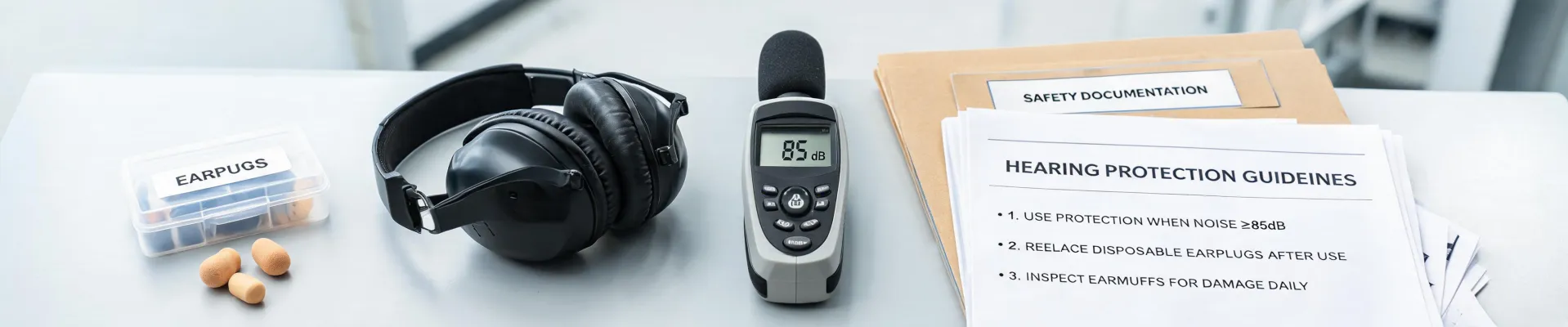
Step 4: Don't confuse "noise-reduction" with hearing protection
-
Step 5: Buy safety shoes by fit trial, not by size number
-
Step 6: Diagnose a beeping detector before you replace it
-
Step 7: Run a quarterly re-verification pass (the step almost everyone skips)
-
What usually goes wrong
I'm a facilities safety coordinator. I've been handling PPE and safety equipment orders for 9 years. In that time I've personally made (and documented) 6 significant mistakes, totaling roughly $14,000 in wasted budget and a couple of very uncomfortable meetings with our EHS director.
This checklist is what I now keep taped to the inside of our supply cabinet. It's for the person who orders or verifies safety gear for a mid-size facility — say, 200 to 500 people, mixed floor and office — and who doesn't have a full-time safety engineer on staff. If you're outfitting a refinery or a chemical plant, stop reading; your requirements are miles past anything I've dealt with.
Seven steps. In order. Each one has a checkpoint you can actually verify.
Step 1: Pin down what "Class 2" actually means before you type a SKU
"Class 2 hard hat" is one of the most mangled terms in safety procurement, and I've gotten it wrong. Here's the mess: depending on who's talking, it can mean Type II protection under ANSI/ISEA Z89.1 (top and lateral impact, as opposed to Type I which is top-only), or it can be shorthand for the high-voltage electrical class — which under the current ANSI/ISEA Z89.1 is Class E at 20,000 V, not "Class 2" — or it can be a mashup with Class 2 high-visibility apparel under ANSI/ISEA 107, which has nothing to do with protecting your head and everything to do with being seen.
My $1,400 mistake: I ordered 40 hats off a spec sheet that said "Class 2," assuming everyone meant the same thing. What my customer actually needed was lateral impact protection for a work area with overhead obstructions. What arrived was Type I with a high-voltage electrical rating. Wrong feature, safe product, useless order.
Before you type a single SKU, write down the exact standard and the exact value you need: ANSI Type (I or II), Electrical Class (C, G, or E), and whether high-visibility is required under a separate standard. Then have the supplier confirm each item in writing.
Checkpoint: the class and type markings are molded into the shell or printed on a label inside. If you can't read them off the actual hat in under 30 seconds, the spec sheet isn't worth much.
Step 2: Find the right manual version before you troubleshoot anything
The manual is not the first PDF you google. The manual is the version that matches the SKU and date code on the device label.
This one cost me half a day and a lot of credibility. A gas detector kept throwing a fault code that the first manual I found translated as "sensor failure." So I ordered a sensor (roughly $230, this was late 2022). The actual fault, per the manual edition printed on the inside back cover of the unit we had, was "calibration gas not detected" — a loose fitting on the calibration cap. The $230 sensor is still sitting in a drawer. (Ugh.)
What I do now, for any Honeywell product manual or any other brand: photograph the label on the unit — SKU, serial, date code — and pull the manual from the manufacturer's own support portal, not from a search engine. Cross-check the revision letter at the bottom of the page before you trust a single symptom table.
Checkpoint: the manual revision matches your device's production range. If you can't confirm that, call support before you buy parts.
Step 3: Work gas detector faults from cheapest to most expensive
Order of operations that has saved me more money than any other habit:
- Power and connection — is it plugged in, is the cable seated, is the tag correct?
- Environment — contamination, condensation, temperature outside the rated range.
- Calibration gas supply — pressure, expiry date, fitting.
- Sensor — and only then.
The temptation is always to jump straight to step 4, because it's the most dramatic answer. In 9 years I've replaced maybe 4 sensors that actually failed. The rest were steps 1 through 3.
Expertise boundary: I'm not a gas detection engineer, and I don't do calibration myself. Once a fault is past the user-level checks, it goes to our certified calibration provider. What I can tell you from a procurement perspective is how to verify that the calibration certificate is current and traceable — that's my lane. Bench work isn't.
Step 4: Don't confuse "noise-reduction" with hearing protection
This one trips people up constantly. A colleague once asked me to order Loop Engage earplugs as "hearing protection" for a team working near a packaging line. I almost did. Loop Engage is a genuinely good product — I use a pair myself for open-plan office noise and for focus work — but it's not PPE. It isn't designed to carry an industrial NRR rating, because it wasn't built as hearing protection.
From the outside, a foam earplug and a Loop Engage look like the same category of object. The reality is that they answer different questions. One is "how do I stop this machine from damaging my hearing," the other is "how do I reduce a distracting room so I can concentrate."
For actual hearing protection, look for an NRR number on the package. NIOSH recommends derating the manufacturer's NRR when you estimate protection for real workers, because lab conditions and a real insertion technique aren't the same thing. If I remember correctly, the plug derating is around a 70% reduction of the published NRR, but confirm that against current NIOSH guidance before writing it into a policy — don't quote me on the exact percentage.
Checkpoint: if the package doesn't list an NRR, it isn't hearing protection. It might still be useful — just not for that.
Step 5: Buy safety shoes by fit trial, not by size number
We standardize on Honeywell safety shoes for the floor team, and the mistake I keep almost making is treating them like sneakers. A size 10 in one model and a size 10 in another model are not the same foot.
What works for us: get two or three candidates in the same nominal size, have the actual wearer try them at the end of the day (feet swell), and walk for at least 5 minutes in each pair. Toe box width and arch support matter more than length on a shift shoe.
The failure mode I've seen: procurement orders 40 pairs of one model in the same size distribution we used for last year's different model, because "the size didn't change." Half come back as "uncomfortable." That's around $3,000 in shoes worn twice that disappear into lockers.
Sample limitation: I've only done this in a climate-controlled plant in a temperate part of the country. If you're outfitting crews rotating through wet or extreme-heat environments, the fit variables and durability tradeoffs look different, and I'd defer to someone with that specific experience.
Step 6: Diagnose a beeping detector before you replace it
This is the question I get most often from outside the facilities team, usually worded as "why is my First Alert smoke detector beeping." The chirp pattern matters more than the sound does.
Common causes, in rough order of likelihood:
- Low battery — a single chirp every 30–60 seconds. Replace the battery, and inspect the module for age.
- End-of-life chirp — a different pattern, typically on detectors around 10 years old. The sensor has degraded and the device is telling you to retire it. Changing the battery does not fix this one.
- Dust or insects — vacuum the vents. (I've done this on a Sunday, in a stairwell, more than once.)
- False alarms from steam or cooking — fix the location, not the device.
- Interconnected alarm — one triggered detector caused the whole network to sound. Check the group, not just the loudest unit.
Look up the chirp pattern in the manufacturer's manual — the pattern, not the sound, is the actual diagnostic code. This is another reason Step 2 exists.
Expertise boundary: I stop at the detector level. Once we're talking about the fire alarm panel, loop wiring, or anything that has to satisfy NFPA 72, that's a licensed fire protection engineer's problem, not mine. I can order the right manual and the right batteries. I can't sign off on the system.
Step 7: Run a quarterly re-verification pass (the step almost everyone skips)
This is the one step I have never seen a small facilities team actually do, and it has caught the most problems for us. Once a quarter, take 45 minutes and walk the real gear, not the spreadsheet.
- Pull the manual edition for each active device type and confirm it still matches the units in service.
- Check class and type markings on hard hats — are they still legible? Is any shell past its replacement date? Manufacturers publish a service life, and it isn't forever.
- Check calibration certificates on gas detectors — current, in date, traceable.
- Spot-check 5 pairs of shoes and 5 sets of earplugs for wear. Foam plugs in particular get reused long past when they should be.
- Test every smoke and CO detector with the test button — not with real smoke, with the button. It's faster and it tells you whether the sensor is alive.
We've caught 3 expired calibration certificates and a batch of hard hats about 6 months past replacement with this pass. That's the kind of thing that doesn't show up until an auditor does.
What usually goes wrong
Three failure patterns I see in other teams, and used to have in my own:
- Buying to the picture, not the standard. Two hard hats look identical until you read the marking. Two earplugs look identical until you read the NRR. Always find the code.
- Trusting the first search result for a manual. Vendor sites, reseller listings, and random scanned PDFs are not the same thing as the current manual from the manufacturer's support portal.
- Skipping the re-verification pass because nothing is broken. Nothing looks broken until the day something is. The quarterly walk is cheap; the surprise is not.
The mindset that has served me best: a good supplier, and a good checklist, will tell you what they don't do. I'd rather buy from a rep who says "we don't cover that end of the system, here's who does" than one who promises the whole thing. A specialist who knows their boundary is worth ten generalists who don't. The vendor who said "this isn't our strength — here's who does it better" earned my trust for everything else we buy from them.
That's the whole list. Steal it, adapt it, and add the mistake that's specific to your facility — because I guarantee there's at least one I haven't made yet.

Pranav Shah
Pranav Shah is a hand and arm protection analyst specializing in cut-resistant gloves, chemical gloves, impact gloves, electrical insulating gloves, disposable nitrile gloves, welding gloves, and protective sleeves. He applies ANSI/ISEA 105, EN 388, EN ISO 374-1, and EN 60903 methods while examining cut level, puncture force, abrasion cycles, permeation breakthrough, impact attenuation, dielectric proof voltage, dexterity, grip, and cuff coverage. His guides help manufacturers, utilities, laboratories, construction teams, and sourcing specialists choose glove systems around the actual hazard, exposure time, tool handling, contamination control, and replacement frequency.