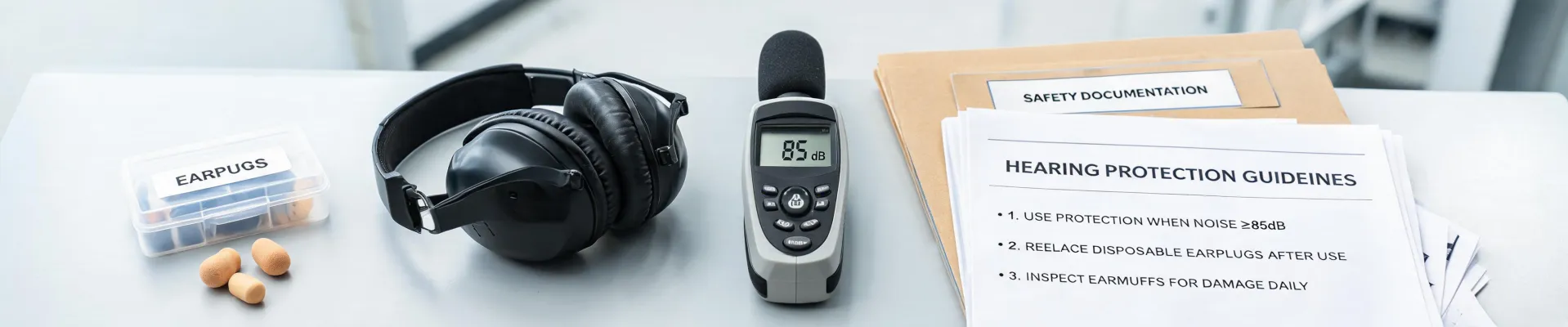
When this checklist applies
Run this before a new crew starts on the floor, before a fire or OSHA inspector is scheduled, and after any incident that put someone on light duty. The walk itself takes about 25 minutes if you know what you're looking at. If something's wrong, it'll blow up into an all-nighter — which is exactly why I moved it to a weekly slot instead of a 'when it comes up' thing.
In March 2024 an inspector gave us 36 hours notice. That afternoon we found 12 hardwired smoke detectors with expired auxiliary batteries, two Peltor Tacsport electronic earmuffs that died ten minutes into the morning shift, and a drawer of welded safety glasses with hairline corner cracks. We fixed it overnight. (Which, honestly, was a miserable night — but still cheaper than a failed inspection.) The checklist below is what we ran, cleaned up and ordered, and it's been a weekly routine ever since.
The six checks
1. Passive earmuffs — seal and headband tension
Run through every pair on the rack. The cushions should feel springy and uncracked, and they should sit flush to the skin. If the foam has gone flat or the surface is polished from use, the ear cup can't seal — which means the rated NRR is no longer your NRR. The 3M Peltor Optime 101 earmuffs are rated at NRR 27 dB. On old, flattened cushions, real-world attenuation is often closer to the low 20s, and there's no notification or badge that tells you this has happened.
Check the headband too. A stretched band isn't a comfort issue — it's an attenuation failure. When the band is relaxed, the gap between the two cups shouldn't open up past roughly half an inch.
The step most people skip: run a finger along the inside of the band. Hair and lint get wound around it, the band loses pressure, and the seal quietly degrades in a way nobody notices until a compliance audit.
2. Electronic earmuffs — batteries, function, and mic
The Peltor Tacsport electronic earmuffs on our shelf — the ones the crew just calls 'Tacsports' — take two AA batteries. The battery indicator on these doesn't fade out gently; it hits a threshold and the unit goes dead. If that happens mid-task on a firing line or a mill floor, you're already behind.
Work through this sequence:
- Open the battery compartment and check the cell date code — not just whether batteries are installed, whether they're fresh.
- Load new cells, then run a continuity test. You should hear ambient sound amplify, and you should hear a clipped response when you clap.
- Inspect the mic ports for dust or metal debris. Blocked ports don't fail loudly — you lose localization and don't notice.
- Pair Bluetooth if the model supports it and play 10 seconds of audio. If it stutters, flag it in the log rather than swapping it into the field kit.
Mistake I've made: assumed a 'spare set' was fresh because it was sitting in the cabinet with the rest. Turned out to be rechargeable AAs from a trade show three weeks earlier — already dead. Everything in the kit gets a date sticker now.
3. Earplugs — model match, fit test, and stock
Before anyone signs out a box, make sure the model matches the noise profile. 3M E-A-R Classic plugs are rated NRR 29 dB, and they're what most of our crew uses. But the rating only applies when they're seated right. Roll the plug down, pull the ear back, hold it until the foam expands — that takes a full 20 seconds. If somebody's done in 10, they haven't sealed anything.
Quick fit check anyone can do: have the wearer say a sentence out loud. If their own voice sounds hollow or stuffed-up, the plug is seated. If it sounds normal, it's not.
Stock gets checked quarterly. Keep a short list of local suppliers you can drive to the same morning — searching 'earplugs near me' at 5 a.m. before a shift gets you a vending-machine company, not the warehouse that actually stocks your model. The fix isn't heroics at 5 a.m. — it's knowing the supplier's phone number the day before.
4. Welding safety glasses — lens condition and Z87.1 rating
Check lenses for scratches, hairline cracks, and coating flaking. Once a lens has crazed, impact resistance during grinding and cutting is no longer guaranteed. And a bent frame won't stay on the face — which means the wearer will be pushing it up every two minutes, defeating the purpose.
Temple arms should carry a 'Z87' or 'Z87+' mark inside. Z87.1 is the standard high-impact baseline; Z87+ has passed a higher-velocity test. For welding specifically, confirm the IR filter and shade number are correct. Shade-3 welding safety glasses are for inspection and light tack work — they're not a substitute for a full-shade welding helmet, and I've seen people find that out the hard way. Don't be one of them.
Cut a small foam-lined case for glasses by size class, so nothing gets jumbled at end of shift. It takes five minutes to build and saves ten minutes every morning.
5. Hardwired smoke detectors — auxiliary battery replacement
This is the one most plant managers wave past, and it's the one that shows up on inspection reports. Hardwired smoke detectors are still code-required by local fire codes, but the auxiliary battery — usually 9V or AA alkaline, depending on model — is what keeps the unit live during an outage. NFPA 72 is the standard behind the requirement. Most manufacturers call for annual replacement of the backup cell, sooner if the unit chirps.
How to change the battery in a hardwired smoke detector without creating a new problem:
- Trip the breaker for the detector's circuit first. Confirm the LED is dark. Don't trust that 'it should be fine.'
- Twist the cover off (usually counterclockwise), pull the old cell, and log the date.
- Seat the new battery, then press and hold the test button for at least 5 seconds. You should hear a sustained alarm.
- Reinstall the cover, restore the breaker, and test again.
The test most people run: press the button, hear a brief chirp, move on. That only confirms the circuit is live — it doesn't confirm the cell switches over cleanly during an outage. Hold the button until the tone rings long enough that you trust it.
One more thing to flag on the walk: alkaline cells fail below freezing. If your facility runs cold storage or a refrigerated bay, use lithium cells with a temperature rating below the space's minimum.
6. Log and label
Write down what was checked, when, and by whom — and sticker the battery swap date on the unit itself. It sounds like admin overhead next to the actual walk, but the log is what turns the next inspection into a 45-minute pass instead of a 10-hour scramble. We run ours on a shared spreadsheet and initial the last cell.
What goes wrong most often
A few things recur every week, and they almost never overlap:
- Skipping the seal test. The earmuffs look fine, but the headband is relaxed or the cushions are compressed. The user assumes 'it's pre-shaped, it's fine.' It isn't.
- Treating 'fresh' as 'just came out of the cabinet.' Battery date codes exist to be checked before the swap, not after the failure.
- Using a scratched lens as a backup. Scratches scatter light; scattered light causes eye strain; eye strain causes users to pop the glasses off. That's when protection goes to zero.
- Testing the smoke detector alarm instead of the battery switch-over. A live alarm doesn't mean the backup cell will hand off cleanly. Hold the button until the unit has finished.
None of this requires expertise. It requires a checklist that fires automatically even when you're tired. Eighteen straight months of running it has got the walk down to under half an hour. Skip it once and you're looking at a night shift instead.

Idris Adebayo
Idris Adebayo is an eye, face, and hearing protection analyst specializing in safety glasses, chemical splash goggles, face shields, welding helmets, laser eyewear, earplugs, and earmuffs. He references ANSI Z87.1, EN 166, and EN 352 while examining optical class, impact rating, shade number, splash coverage, anti-fog performance, attenuation by frequency, NRR, seal pressure, fit, and compatibility with other PPE. His evaluations help industrial hygienists, fabrication shops, laboratories, and procurement teams control impact, radiation, chemical splash, and occupational noise exposures without undermining comfort or communication.