-
The 7-step PPE verification checklist
-
Step 1: Match the hazard assessment to the product, not the category
-
Step 2: Verify respirator certifications against the actual spec sheet
-
Step 3: Confirm head protection class and brim type
-
Step 4: Write the earplug protocol down
-
Step 5: Cross-check supplier credentials through the manufacturer portal
-
Step 6: Photograph and archive the first delivery
-
Step 7: Confirm training records match the equipment
-
Step 1: Match the hazard assessment to the product, not the category
-
Common mistakes and caveats
I review PPE orders before they hit our production floor. Over 4 years and roughly 200+ unique items a year, I've bounced somewhere around 8% of first deliveries—wrong certifications, mismatched part numbers, specs that look right on the invoice but don't hold up under a caliper. The checklist below is what I actually run. Not a theoretical framework. Seven steps, about 45 minutes per order once you know what you're looking for.
If you're a safety manager, procurement lead, or ops engineer signing off on PPE, this is for you. If you're shopping for a single pair of safety glasses, skip it—this is overkill for one-off purchases.
The 7-step PPE verification checklist
Step 1: Match the hazard assessment to the product, not the category
Most PPE orders start with a category—"respirators," "hard hats," "hearing protection." That's the wrong starting point. Before you look at a single SKU, pull up the hazard assessment for the task the PPE is meant to cover.
I don't have hard data on how many companies actually do this, but based on the vendors I've worked with, my sense is most skip it. They buy the category, not the specific hazard. Which works fine until an inspector asks why a Class C hard hat is being used near exposed conductors, or why a half-mask respirator was specified for an atmosphere that requires full face protection.
What this looks like in practice: write down the hazard—impact, chemical, particulate, noise level in dB—then write the product spec that addresses it. If they don't match line by line, stop.
Step 2: Verify respirator certifications against the actual spec sheet
This is where I've seen the most expensive mistakes. For something like the Honeywell full face respirator 5400 series, you're looking at a NIOSH-approved unit—but "NIOSH-approved" isn't a single thing. It depends on the cartridges, the fit test protocol, and the use case.
What I check:
- NIOSH approval number on the actual unit, not just the box
- Cartridge compatibility—the wrong cartridge can void the whole approval
- Fit test documentation for the user; OSHA 29 CFR 1910.134 requires it annually
- Face seal check instructions, not just "check the seal"
The 5400 series spec sheet lists approved cartridges. Cross-reference against what the vendor is shipping. I've seen a vendor substitute a cartridge that was "functionally equivalent" and it was—except it wasn't approved for that facepiece. Full stop.
Step 3: Confirm head protection class and brim type
Hard hats are one of those categories where the catalogue looks uniform and the reality is not. Two things matter for verification:
Class: G (general, up to 2,200V), E (electrical, up to 20,000V), or C (conductive—no electrical protection). ANSI Z89.1 defines these. If you're in an environment with electrical exposure, a Class C hat is a paperwork problem waiting to happen.
Brim type: Full brim vs. cap style. A full brim hard hat gives a bit of rain and sun coverage and protects the neck on impact. Cap style fits into tighter spaces. Neither is "better"—they solve different problems. If your team is working outdoors in variable weather, full brim is probably the safer default.
Where the "lift hard hat" category gets confusing: it's not a standard ANSI classification. Different vendors use it to mean different things—some use it for ratchet suspension, some for a specific shell profile. Ask for the spec sheet, not the marketing name. And verify the suspension type (4-point vs. 6-point) against what your hazard assessment calls for.
Price note: full brim and lift-style hard hats are running roughly $25–60 per unit depending on suspension and class (based on distributor quotes I collected in early 2025; verify current pricing). The difference between a $25 base model and a $45 one is usually the suspension system, not the shell.
Step 4: Write the earplug protocol down
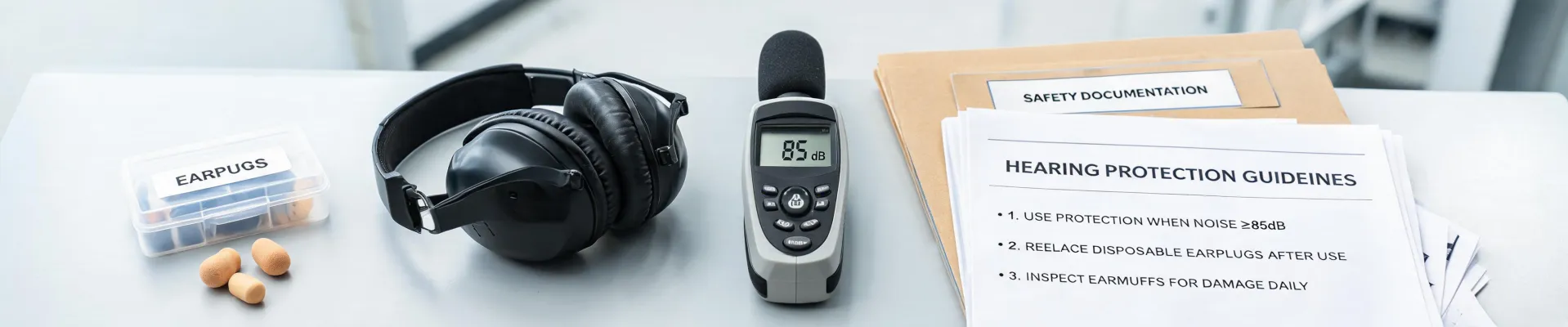
This is the step most teams skip, and it's the one that comes up in audits. "Is it bad to wear earplugs every night?"—I've been asked this by employees more than once. The honest answer depends on context.
For occupational exposure: earplugs are designed for repeated use during shifts. OSHA 29 CFR 1910.95 sets the noise exposure limits (90 dBA for 8 hours, with a 5 dB exchange rate—so 95 dBA for 4 hours, and so on). Wearing them every shift isn't just fine, it's the point.
For sleep: different use case. Long-term nightly earplug use can cause earwax compaction or minor irritation for some people. That's not an occupational safety issue—it's a personal health question. I'm not a doctor, and I tell employees the same thing: if nighttime use is causing discomfort, talk to someone who knows the ear.
Write your protocol down. Which tasks require hearing protection, what NRR rating, how often plugs get replaced, and how you handle the sleep-use question when it comes up. Having it in writing saves you a headache during an audit.
Step 5: Cross-check supplier credentials through the manufacturer portal
This is the step that has saved me the most time. Before I sign off on any Honeywell order, I run the supplier's credentials through the manufacturer portal—Honeywell login, verify authorized distributor status, check warranty terms. A few minutes of portal work has caught more problems than any inspection I've ever done.
Why it matters: unauthorized or gray-market distributors sell real products with no warranty support. You find out when something fails and the manufacturer says "we didn't sell that to you." The FTC requires that advertising claims be truthful and substantiated (FTC Business Guidance on Advertising), but verifying authorization is your job, not theirs.
What to verify in the portal:
- Authorized distributor status for the specific product line
- Warranty registration pathway
- Product lifecycle status—discontinued vs. current
- Recall notices for the SKU
Step 6: Photograph and archive the first delivery
I assumed "same specifications" meant identical results across vendors. Didn't verify. Turned out each had slightly different interpretations of "matches spec"—especially on coating thickness and label placement. We had a batch that looked right on the invoice and wrong on the floor.
Now every first delivery gets photographed: packaging, labels, the unit itself, the certification stamp. Archived with the PO number. When the second batch shows up and something's off, I have a baseline. This has ended three vendor disputes in our favor without escalation.
So glad I started doing this. Almost skipped it to save 10 minutes per order. It's caught two material substitutions and one packaging change that would have voided a warranty claim.
Step 7: Confirm training records match the equipment
The most frustrating part of PPE management: the same issues recurring despite clear communication. You'd think written specs would prevent misunderstandings, but interpretation varies. And training records are where that shows up.
Your training log needs to match the equipment actually in use. If you're switching to a full face respirator for a task, the training has to cover full face—not just the half-mask your team used before. If you're standardizing on full brim hard hats, the training covers suspension adjustment for that specific model.
Before sign-off, I check:
- Training records are dated after the last equipment change
- Each equipment model on the floor has a training module attached
- Annual refresher dates are tracked—OSHA requires this for respirators
Common mistakes and caveats
Don't skip the spec sheet because the brand is trusted. Honeywell makes excellent products—that's why we buy them. But their catalogue is huge, and the specs on the unit you receive need to match the specs on the PO. Trust the brand, verify the SKU.
Don't let price drive the verification timeline. The lowest quote has cost us more in roughly 60% of cases I've tracked—usually in rework, delayed shipments, or rejected batches. That $200 savings turned into a $1,500 problem more than once. This is the value-over-price thing in practice: you're not comparing two identical products at different prices. You're comparing two products with different hidden cost structures. In my experience, the extra hour of verification on the front end pays for itself about 4 times out of 5.
Context matters. This checklist worked for us, but we're a mid-size operation with predictable ordering patterns and a dedicated quality function. If you're a smaller team without a full-time quality inspector, some of these steps will need to be batched—do the portal verification quarterly instead of per-order, for example. If you're a large enterprise with procurement automation, several of these steps should be automated into your PO system.
I can only speak to domestic operations. If you're sourcing internationally, there are probably factors I'm not aware of—customs holds, certification reciprocity, that sort of thing.
One last thing: write the checklist down and version it. Mine is at v4 now. Every time I get burned, a line gets added. That's the whole system.

Yvonne Mensah
Yvonne Mensah is a high-visibility and protective workwear analyst covering safety vests, reflective jackets, rainwear, coveralls, flame-resistant clothing, arc-rated garments, and disposable protective suits. She uses ANSI/ISEA 107, NFPA 2112, and IEC 61482-2 requirements while comparing background-material area, retroreflective performance, garment class, arc rating, thermal shrinkage, seam strength, breathability, water resistance, sizing, and laundering durability. Her work helps road contractors, utilities, oil and gas teams, manufacturers, and buyers select clothing for visibility, flame, arc, weather, contamination, mobility, and heat-stress demands.