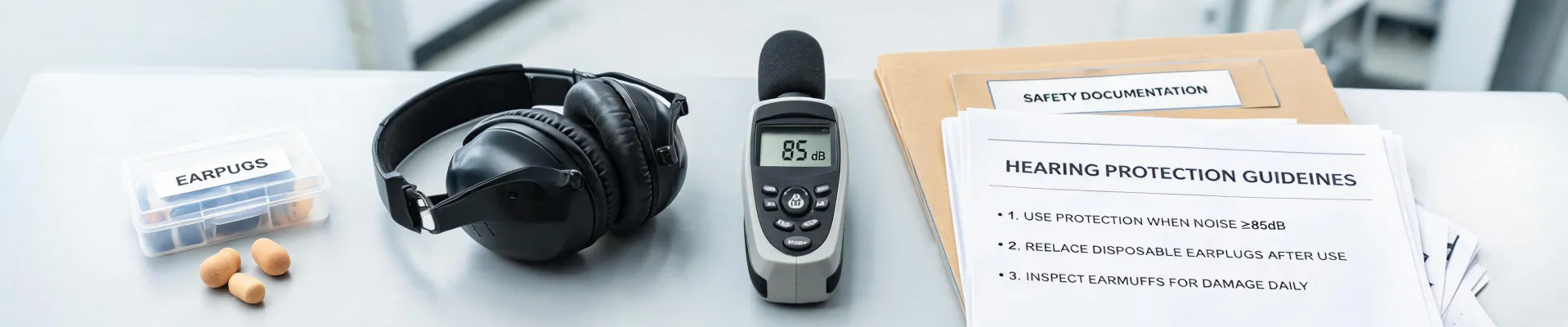
I review every hearing protection spec that reaches our facility—roughly 200 PPE items a year, each one checked against certification paperwork before it's cleared for use. In the past 12 months, I've rejected 8% of first deliveries for missing NRR documentation or incorrect labeling. Take it from someone who signs off on this stuff: the product name on the box matters far less than whether it actually protects the person wearing it.
The question I get from our procurement team more than any other is whether we can standardize on a single hearing protection product. The two candidates are always the Howard Leight MAX earplugs (NRR 33) and the Howard Leight Impact Pro electronic earmuffs (NRR 30). They sit at opposite ends of the price spectrum—pennies per pair versus several hundred dollars—and yet the comparison keeps coming up because both serve the same fundamental requirement: keeping an 8-hour noise exposure below the OSHA 85 dBA action level (29 CFR 1910.95).
To settle it properly, I compare them on five dimensions: raw protection rating, real-world wear, situational awareness, cost per worker over time, and compliance auditability. Here's the breakdown.
Dimension 1: Raw Protection Numbers
The MAX earplug's NRR 33 is the ceiling for foam earplugs—you can't get a higher passive rating from a disposable product. If you check the Howard Leight MAX earplugs NRR 33 official site, you'll see that rating displayed prominently, and it's legitimate. The Impact Pro electronic earmuff carries an NRR of 30. On paper, MAX wins by 3 decibels. Both NRR values are verified through third-party testing under the EPA's product noise labeling regulation (40 CFR Part 211).
In practice, that 3 dB difference is almost meaningless. Both products get a typical wearer far below the OSHA action level for a full shift. And both are available in forms that fit under welding helmets and hard hats—the MAX in low-profile foam, the Impact Pro with slim-profile ear cushions. If your work environment sits in the 90–100 dBA range, either product provides adequate attenuation.
What matters more than the 3 dB gap is the risk of over-protection. In moderate noise (85–95 dBA), an NRR 33 earplug can isolate a worker so thoroughly that they can't hear approaching equipment or verbal warnings. An NRR 30 electronic muff actually solves that problem by amplifying ambient sounds to safe levels, which brings us to the dimensions that matter more.
Conclusion: MAX wins the spec sheet by a negligible margin; the rating difference rarely matters in the field.
Dimension 2: Real-World Protection (The Counterintuitive Part)
Here's the conclusion that surprises auditors every time: the Impact Pro often protects people better than the MAX, despite the lower NRR.
Lab attenuation ratings assume a perfect fit and correct insertion every single time. Real workers don't behave that way. I've watched a new hire squish a MAX earplug, shove it in at the wrong angle, and head straight for the grinding line. His effective protection was maybe 10–12 dB, not the 33 dB printed on the package. NIOSH fit-test research consistently shows that real-world attenuation for foam earplugs runs 20–30% below the labeled rating unless workers are individually trained and fit-tested.
The data said MAX was the obvious choice—$0.15 a pair versus a $350 earmuff. Every cost projection pointed in that direction. My gut said something was off. So in Q3 2024, I ran a small internal observation across 14 workers on a metal-finishing line for three weeks. With MAX earplugs, wear-time compliance sat at roughly 70%. Guys pulled them out during breaks to talk, then didn't always reinsert them. Two workers flat-out admitted they'd thrown away earplugs because they felt "uncomfortable." The same crew issued Impact Pro earmuffs? 93% wear-time compliance. The built-in microphones let them hear conversations, so they forgot the protection was in place.
If the product doesn't stay on, the NRR on the box is just a number. Real-world protection equals the attenuation that reaches the inner ear while the product is actually in position, multiplied by wear-time. The Impact Pro wins that equation for any worker who wears hearing protection for most of a shift.
Conclusion: For full-shift workers, the Impact Pro delivers more actual attenuation in practice despite being rated lower.
Dimension 3: Situational Awareness
Many safety managers overlook this dimension because it never appears on a spec sheet. MAX earplugs block everything—the forklift horn, the overhead crane warning, the co-worker shouting before you step into a blind corner. In environments with moving equipment or changing conditions, suddenly deafening a worker creates a new hazard.
The Impact Pro solves this with external microphones that amplify ambient sound to a safe, comfortable level while electronic circuitry limits noise above 82 dBA. Speech and warning signals come through crisply; impulse noise gets suppressed almost instantly. Workers in dynamic environments keep their hearing protection on without losing the ability to hear what's happening around them.
I used to frame this as "comfort versus protection"—a trade-off where you pick one. That framing is wrong. Situational awareness is part of the protection. A worker who misses the backup alarm on a forklift because earplugs sealed out the world has traded noise-induced hearing loss for a potential crushing injury. For roles that require communication—maintenance crews, loading docks, any team working near moving vehicles—electronic earmuffs are the safer choice, full stop.
Conclusion: The Impact Pro wins decisively for roles requiring communication, mobility, or awareness of audible alerts.
Dimension 4: Cost Per Worker Per Year
Procurement math usually compares sticker prices. Here's the lifecycle math instead.
A Howard Leight MAX earplug in bulk costs about $0.15–$0.30 per pair (distributor pricing as of January 2025). A worker using two pairs per shift across 240 working days costs roughly $75–$145 per year in disposables. Add the hidden cost of inventory management: restocking dispensers, tracking usage, cutting off pilferage. We didn't have a formal restocking process at first. The third time a dispenser ran dry on a production line, I finally added a weekly replenishment checklist. Small thing, real cost.
The Impact Pro retails around $300–$400, with street prices near $350, plus $25–$35 annually for replacement hygiene kits (ear cushions and foam inserts). Over a three-year service life, annualized cost is $125–$170 per worker—in the same ballpark as high-usage disposables. The trade-offs: you need the upfront budget, and the muffs draw two AAAs roughly every 300 hours of use. If the batteries die mid-shift, the unit still passively blocks around NRR 24, so it degrades gracefully rather than failing completely.
For a facility with high turnover or intermittent noise exposure, MAX earplugs are the pragmatic call—zero maintenance, no battery, no headband to break. For a crew of long-tenured operators in continuously noisy roles, the Impact Pro comes out financially comparable and operationally superior.
Conclusion: Roughly cost-neutral over a three-year horizon; MAX wins with high turnover, Impact Pro wins with stable crews.
Dimension 5: Compliance Verification
As the person who signs the audit paperwork, this is where I have the strongest opinion. The two products demand completely different verification efforts.
MAX earplugs require fit training, periodic fit testing, and constant visual checks. We learned this the hard way in 2023, when a recordable incident traced directly to a worker wearing earplugs incorrectly. That mistake triggered a $22,000 consulting engagement and a corrective action plan that ate three months of my calendar. Now every new hire goes through supervised insertion training and a seal check before their first shift.
The Impact Pro is dramatically easier to audit. Headband tension is visible at a glance. The ear cushions show their wear on the outside. A supervisor can check battery status and electronic function in under thirty seconds, without stopping production. For a compliance manager who has to stand behind audit results, this auditability is worth real money.
There's also a time-certainty angle. When our next audit window was approaching and I had to guarantee the program would hold up, the $350 purchase price for a set of Impact Pro muffs didn't feel expensive at all. The certainty of a verifiable, wear-time-validated program is the kind of thing you pay a premium for once and stop worrying about. An uncertain, hard-to-verify program can cost you far more at the exact moment you need it to hold up.
Conclusion: The Impact Pro is materially easier to verify and audit than disposable foam earplugs.
Which Should You Choose?
Here's the practical guidance I give our operations team:
- Choose MAX earplugs when your workforce turns over quickly, noise exposure is moderate and steady (under 100 dBA), the environment is dusty or chemical-heavy (conditions that degrade earmuff seals), or you can't free up the upfront budget. Just buy from an authorized Howard Leight distributor—counterfeit foam plugs are a genuine problem, and the NRR printed on a fake package is fiction.
- Choose Impact Pro earmuffs when your core workers spend full shifts in high noise, need to communicate with each other, or work around moving equipment where audible warnings matter. The upfront cost buys two things: protection that people actually keep on, and compliance evidence you can verify in a thirty-second walkthrough.
Still on the fence? Run a two-tier program: Impact Pro for long-shift operators, MAX as backup stock and for short-term visitors. That hybrid structure is what we've settled on, and our hearing conservation metrics have been stable since we made the change.
Bottom line: stop buying the highest NRR number. Buy the protection your workers will keep on. The Howard Leight Impact Pro, with its lower rated NRR, consistently delivers more real-world protection for the people who need it—and it's a no-brainer for compliance teams that value certainty over speculation.

Maeve Callahan
Maeve Callahan is a head-protection analyst covering Type I and Type II hard hats, climbing-style safety helmets, bump caps, chin straps, suspensions, liners, and face-shield carriers. She applies ANSI Z89.1, EN 397, and EN 12492 criteria while comparing impact attenuation, penetration resistance, lateral deformation, electrical class, retention strength, field of vision, mass, fit range, and temperature conditioning. Her guides help EHS teams, contractors, utilities, and buyers select helmet systems for overhead hazards, work at height, electrical exposure, accessory compatibility, and worker acceptance.