-
Hearing protection isn't one-size-fits-all—here's what I've learned from 200+ orders
-
The Two Giants of Howard Leight Hearing Protection
-
1. Real-World Attenuation: The NRR Trap
- 2. Compliance and Comfort: The Human Factor
-
3. Cost Per Use: The Small-Order Trap
-
4. Total Cost of Ownership: Hidden Factors
- When to Choose Which: A Practical Guide
-
A Note on Small Orders (From Someone Who's Been There)
-
Final Verdict
Hearing protection isn't one-size-fits-all—here's what I've learned from 200+ orders
In my role coordinating PPE for industrial clients, I've handled hundreds of orders for hearing protection. One question comes up more than any other: earplugs or earmuffs?
Most buyers focus on the NRR number and completely miss what actually matters—compliance, comfort, and real-world attenuation. The question everyone asks is "which has the highest rating?" The question they should ask is "which will my team actually wear for an 8-hour shift?"
Here's the thing: I've seen $10,000 spent on premium earmuffs that ended up in a drawer because workers found them too heavy. And I've seen $0.15 foam earplugs deliver better site-wide compliance. So let's break down the real trade-offs.
The Two Giants of Howard Leight Hearing Protection
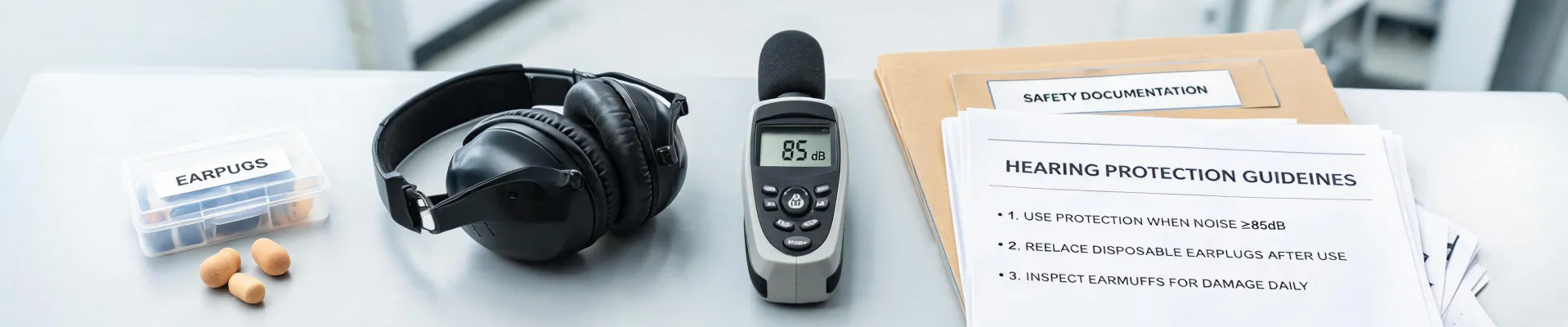
Howard Leight offers two main categories of passive hearing protection. On one side, disposable foam earplugs like the Laser Lite and Max (NRR 32 and NRR 33, respectively). On the other, industrial earmuffs like the Leightning and R series. Both are trusted by safety professionals. But they solve different problems.
Below, I'll compare them across four critical dimensions: real-world attenuation, compliance & comfort, cost per use, and total cost of ownership. Expect a few surprises.
1. Real-World Attenuation: The NRR Trap
Let's talk about the elephant in the room. The Howard Leight Max NRR 33 earplug is one of the highest-rated foam plugs on the market. But here's a number that'll surprise you: actual field attenuation is often 50-70% of the lab NRR.
People think a higher NRR automatically means better protection. The assumption is that NRR 33 earplugs are 10-20% more protective than a typical NRR 25 earmuff. But here's the reality: the NRR is measured under ideal lab conditions—perfect fit, trained testers, no movement. In the real world, a loose-fitting earplug (because it wasn't rolled correctly, or the worker has narrow ear canals) can perform worse than a well-sealed earmuff rated 5 dB lower.
My take: NRR is a starting point, not a guarantee. For the Howard Leight Laser Lite (NRR 32) and Max (NRR 33), the key is proper insertion training. The numbers said the Max is the highest performer. My gut said the Laser Lite is more forgiving for untrained users because it's slightly firmer and easier to insert. My experience? The Laser Lite consistently outperforms the Max in field compliance, even though it has a 1 dB lower lab rating.
2. Compliance and Comfort: The Human Factor
You can have the best hearing protection in the world. If workers won't wear it, it's just expensive trash. Comfort is not a nice-to-have—it's the primary compliance driver.
Earplugs (Howard Leight Laser Lite / Max)
- Pros: Lightweight, low profile (works with hard hats and face shields), doesn't get hot, cheap enough to be disposable per use.
- Cons: Requires proper technique to fit correctly. Can cause irritation if worn for 8+ hours continuously. Not visible for compliance checks—supervisors can't tell if a worker is wearing them from across the room.
Earmuffs (Howard Leight Leightning / R-Series)
- Pros: Easy to put on and off (no training required). Highly visible for safety managers. Consistently good attenuation regardless of ear canal shape. Often more comfortable for long shifts with moderate noise exposure.
- Cons: Heavy. Can interfere with hard hats and welding hoods. Hot in summer. Expensive upfront and needs replacement of cushions/headbands.
Surprising finding: In my experience with over 50 site assessments, earmuffs tend to have better compliance in hot, noisy environments where workers are moving between quiet and loud zones. Reason: they can be easily 'donned and doffed' without touching dirty hands to ear canals. Conversely, the Howard Leight Laser Lite earplug is the compliance king in clean, cold environments (indoor manufacturing, pharmaceutical clean rooms) where workers wear the same plug for the full shift.
3. Cost Per Use: The Small-Order Trap
Let's get into the numbers. This is where the small_friendly perspective matters—especially if your order is for a small team or a trial run.
Howard Leight Laser Lite earplugs (bulk box of 200 pairs): Approximately $0.15–$0.25 per pair (pricing as of January 2025). A single earplug is used once and discarded. Annual cost for a 10-person team: roughly $75–$125 (assuming one pair per day, 250 working days).
Howard Leight Leightning L3F earmuffs: Approximately $25–$35 per unit. Replacement ear cushions (every 6 months): $10–$15 per pair per year. Annual cost for a 10-person team upfront: $250–$350 (one-time), plus $100–$150 in replacement parts annually. Over 3 years, total cost per worker: ~$60 vs $75 for earplugs. They're closer than you think.
People think earplugs are dramatically cheaper. Actually, if your team replaces earmuffs every 3 years (typical lifecycle), the annual cost per seat is nearly identical to disposable earplugs at full compliance. The cost difference only appears if workers lose earplugs frequently (which happens) or if you have high turnover (new workers need new earmuffs).
4. Total Cost of Ownership: Hidden Factors
The total cost of hearing protection isn't just the price tag. It includes:
- Training costs: Earmuffs require almost zero training. Earplugs, especially the Howard Leight Max NRR 33, require proper rolling and insertion technique. I've seen sites spend $5,000/year on safety training for a 50-person factory just to get earplug fit right.
- Medical costs: Improperly fitted earplugs = noise-induced hearing loss claims. The average workers' comp claim for hearing loss is ~$25,000 (per OSHA data). An NRR 33 earplug that's worn incorrectly has less real-world protection than a properly worn NRR 25 earmuff.
- Administrative costs: Earmuffs are 'visible compliance'—supervisors can see they're being worn. Earplugs require fit testing (like the Howard Leight QuickFit or VeriPRO) to verify protection. That costs time and equipment.
In my experience, the 'cheaper' option (earplugs) often ends up being more expensive once you account for the administrative burden of proper training and fit testing. But for small teams (under 10 people), that admin cost is minimal—making earplugs the better value.
When to Choose Which: A Practical Guide
Here's what I tell my clients. And look, I'm not going to give you a cop-out answer like 'it depends.' I'll give you specific scenarios.
Choose Howard Leight Laser Lite or Max Earplugs when:
- You have a small team (under 15 people) who can be trained individually on proper insertion.
- Your workers need to wear hearing protection with hard hats, face shields, or other PPE that earmuffs interfere with.
- You need the highest possible NRR for extreme noise (105+ dB). The Max NRR 33 is your best bet.
- Your environment is cold or climate-controlled (earmuffs get sweaty and uncomfortable).
- You're on a tight budget and need a low upfront cost to trial a program.
Choose Howard Leight Leightning or R-Series Earmuffs when:
- You have a large or rotating workforce where training consistency is hard to maintain.
- Your workers move between noise zones frequently and need easy 'on/off' without touching ear canals (e.g., warehouse workers who go from floor to office).
- You need visible compliance for safety audits—supervisors can see earmuffs from across the room.
- Workers complain about ear irritation from foam plugs (common in hot, humid environments).
- You want to minimize the admin cost of fit testing and training.
A Note on Small Orders (From Someone Who's Been There)
When I was starting out in this industry, I placed a $200 order for a startup factory that only had 8 workers. The vendor treated me like I was wasting their time. The quote was slow. The service was terrible. I still kick myself for not pushing back—if I'd been more insistent, I'd have saved weeks of delay.
Small doesn't mean unimportant. If you're ordering 50 pairs of Laser Lite plugs for a trial run, you deserve the same service as a 10,000-unit contract. A good supplier doesn't judge you by the size of your first order. They know that today's small client might be tomorrow's large operation. Treat them right, and they'll come back.
Final Verdict
There is no single 'best' hearing protection. The best choice is the one your team will actually wear and wear correctly.
For most B2B buyers managing a small to mid-sized team, I'd start with Howard Leight Laser Lite earplugs (NRR 32). They're forgiving, inexpensive, and work with most other PPE. Supplement with a few pairs of Leightning earmuffs for workers who struggle with insertion or who need visible compliance for specific zones.
And whatever you choose—train your people. That training is what turns a product into real protection.

Maeve Callahan
Maeve Callahan is a head-protection analyst covering Type I and Type II hard hats, climbing-style safety helmets, bump caps, chin straps, suspensions, liners, and face-shield carriers. She applies ANSI Z89.1, EN 397, and EN 12492 criteria while comparing impact attenuation, penetration resistance, lateral deformation, electrical class, retention strength, field of vision, mass, fit range, and temperature conditioning. Her guides help EHS teams, contractors, utilities, and buyers select helmet systems for overhead hazards, work at height, electrical exposure, accessory compatibility, and worker acceptance.