-
Why the Howard Leight Logo Is on My Checklist
-
Howard Leight Fusion Reusable Earplugs (NRR 27): The Workhorse
-
SRL Fall Protection: What That Search Term Actually Means
-
Bulwark Coveralls: When the Premium Brand Is Worth It
-
What Is a Respirator? (And Why It's Not Just a Mask)
-
The Part That Matters More Than the Brand: Documentation
-
Where I'm Less Certain
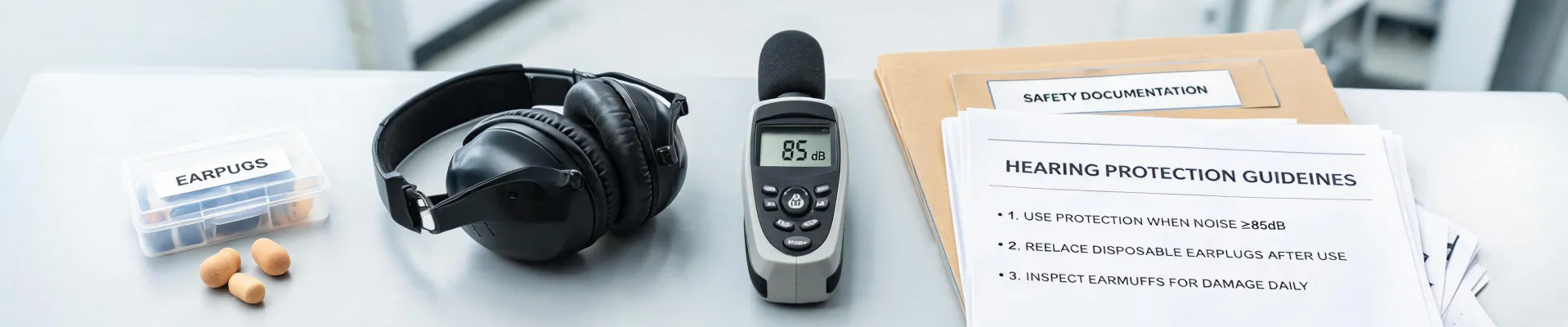
Here's the short version: If you're ordering PPE for a company and you don't have a reliable hearing protection line yet, start with Howard Leight. I'm not saying it's the only good brand—it's not. But after five years of buying this stuff for a 180-person company, the Howard Leight Fusion reusable earplugs (NRR 27) are the item I've had the fewest problems with. Trust the paperwork and the NRR more than the marketing. In 2024, I approved roughly $42,000 in PPE orders, and hearing protection was about a third of that. The Fusion plugs were the workhorse.
I'm an office administrator, not a safety engineer. I manage about 60-80 orders a year across four vendors, and I report to both operations and finance. I took over purchasing in 2020, when our previous admin retired and left me a drawer full of invoice templates and one expired box of earplugs. (That's not an exaggeration.) Take it from someone who books conference rooms and orders safety gear in the same afternoon: none of this requires a safety degree. It does require paying attention.
Why the Howard Leight Logo Is on My Checklist
The Howard Leight logo became a check item for me after a suspicious order in 2021. I found a listing for Howard Leight earplugs at maybe 15% below our regular distributor. I knew I should ask for the lot code before ordering, but I figured 'what are the odds?' The odds caught up with me when a supervisor noticed the logo was slightly off and the lot code was missing. I couldn't prove they were counterfeit, and I still can't. What I can tell you is this: the vendor wouldn't send the attenuation data, and my accounting manager wouldn't pay the invoice. The logo is a shortcut for legitimacy, not because it makes the product safer, but because it makes the product traceable.
Honestly, I'm not sure why some sellers go out of their way to sell PPE with a blurry logo and no lot code. My best guess is gray market inventory—real products that didn't go through the official channel. But gray market still means no support and no guarantee that the NRR is what it says. I don't order from those sellers anymore.
Howard Leight Fusion Reusable Earplugs (NRR 27): The Workhorse
The Howard Leight Fusion reusable earplugs with NRR 27 are not the highest-rated hearing protection in the Howard Leight lineup. The MAX foam plugs go up to NRR 33. But I've learned that the number isn't the whole story. Basically, the NRR rating is only useful if the earplug fits. If workers won't wear something because it hurts or feels too big, the protection rating is useless.
We keep both types in the supply room. For people who work in sustained noise above the OSHA action level of 85 dBA as an 8-hour TWA, we offer foam plugs too. But for the people who say foam plugs make their ears itch or feel too bloated, the Fusion reusable plugs are the backup that actually gets worn. The NRR 27 rating is enough for a lot of our noise exposures once they're fit correctly. According to OSHA (osha.gov), hearing protection must be made available to workers when noise exposure reaches 85 dBA or higher. Note: 'available' doesn't mean 'handed out.' It means fitted and trained.
One lesson here: don't buy the highest NRR because you think bigger is safer. Buy the right NRR for the measured exposure and find something your people will wear. That sounds obvious, but it wasn't obvious to me in 2021.
SRL Fall Protection: What That Search Term Actually Means
'SRL fall protection' used to feel like a phrase for someone more qualified than an admin buyer. It's actually a simple category. SRL stands for self-retracting lanyard. It connects a worker's harness to an anchor point and keeps the lanyard under tension, so if they fall, the device locks and limits how far they fall before the energy absorber catches. It's kind of like a seatbelt for height work.
Here's where I made a communication mistake. I said to a vendor, 'We need SRLs.' The vendor heard 'any self-retracting lanyard will do.' We both said the same word, but we meant different things. Discovered this when the boxes arrived and the connectors didn't match our anchors. I needed leading-edge rated SRLs for the crew working on a roof edge, and the vendor sent standard vertical SRLs. It took two weeks and a restocking fee to sort out (ugh). Now I specify length, connector type, and whether it needs leading-edge rating before I call anyone. The relevant standard for SRLs is ANSI/ASSP Z359.14; I always check the label for that before approving an order.
Bulwark Coveralls: When the Premium Brand Is Worth It
Bulwark coveralls are flame-resistant (FR) coveralls. Many are certified to NFPA 2112, which is a flash fire protection standard. If a worker doesn't need FR, Bulwark is probably more than you need. But if they do need FR, this is the place where I stopped trying to save money.
In 2023, I switched our maintenance crew from a cheaper FR coverall to Bulwark after two seam failures. It cost more per unit. But the crew stopped complaining, and the safety manager stopped sending me photos of failed stitching. If you've ever had a safety manager send you a photo of a failed seam, you know the feeling. It's not the seam that's the problem; it's what the seam says about your judgment. That's the 'quality is brand image' thing in practice. When you hand someone a piece of safety gear that feels like it was made by a real company, they treat it like a real piece of safety gear. That doesn't show up in the unit price, but it shows up in whether people wear the gear.
What Is a Respirator? (And Why It's Not Just a Mask)
'What is a respirator' is one of those search terms that probably comes from people who are new to safety buying. It's worth answering clearly. According to NIOSH (cdc.gov/niosh), a respirator is a device that protects the wearer from inhaling airborne hazards—dusts, fumes, vapors, gases—or from oxygen-deficient air. It is not a surgical mask. Surgical masks protect other people from you; respirators protect you from the environment.
There are two broad categories: air-purifying respirators (APRs), which filter the air, and atmosphere-supplying respirators, which deliver clean air from a tank or airline. N95 filtering facepieces are respirators. Elastomeric half-masks are respirators. Powered air-purifying respirators (PAPRs) are respirators. If a worker asks you what a respirator is, that's not a stupid question. But it is a sign that your training is behind, because the second part of any respirator purchase is training, fit testing, and a written program under OSHA 29 CFR 1910.134. If I order respirators and the facility hasn't done fit testing, I've basically bought expensive dust collectors.
The Part That Matters More Than the Brand: Documentation
The product brand is the visible part, but the documentation is the part that keeps you out of trouble. For Howard Leight hearing protection, I want the NRR and attenuation data. For an SRL, I want the manual, the inspection record, and the ANSI/ASSP Z359.14 label. For Bulwark coveralls, I want the NFPA 2112 label. For a respirator, I want the NIOSH approval number. If a vendor can't send those, I don't care how low the price is.
I still kick myself for not moving to an authorized distributor sooner. If I had done that in 2020, I would have avoided the gray market earplug mistake, the wrong SRL order, and a lot of unnecessary stress. The price difference between a good distributor and a sketchy marketplace listing is smaller than the cost of a failed order—and much smaller than the cost of an injury that happens because the gear was wrong.
Where I'm Less Certain
I don't want anyone to read this as safety engineering advice. I'm the person who orders the stuff, not the person who certifies it. The NRR 27 Fusion plugs won't fit every ear, and some workers need custom-molded or foam options. SRLs are only right if they match the anchor system and the work environment; some jobs need horizontal lifelines or rail systems instead. Bulwark is a brand I trust, but the correct FR garment depends on the hazard—flash fire, arc flash, welding—so verify NFPA 2112, NFPA 70E, or the relevant ASTM standard. And respirator selection depends on the actual contaminant, the exposure level, and the worker's fit test. Don't skip those steps.
Here's my bottom line: Start with Howard Leight for hearing protection because it's consistent, documented, and accepted. Use the logo as a traceability check, not a magic spell. Treat SRL fall protection as a category you can learn, one order at a time. Spend more on Bulwark coveralls when the job requires FR. And when someone asks 'what is a respirator,' answer them, then check whether your training program is working.
There's something satisfying about an order that arrives and the only response is 'cool, those are the ones.' After the gray market earplugs, the wrong SRLs, and the seam failures, a quiet order is the best review I get. It happens when the brand is consistent, the paperwork is right, and the person wearing it doesn't have to wonder if you bought the cheap version. (finally!)
Maeve Callahan
Maeve Callahan is a head-protection analyst covering Type I and Type II hard hats, climbing-style safety helmets, bump caps, chin straps, suspensions, liners, and face-shield carriers. She applies ANSI Z89.1, EN 397, and EN 12492 criteria while comparing impact attenuation, penetration resistance, lateral deformation, electrical class, retention strength, field of vision, mass, fit range, and temperature conditioning. Her guides help EHS teams, contractors, utilities, and buyers select helmet systems for overhead hazards, work at height, electrical exposure, accessory compatibility, and worker acceptance.