-
Step 1: Map Your Noise Zones Before Opening Any Product Catalog
-
Step 2: Verify Real-World Attenuation — Don't Chase the Highest NRR
-
Step 3: Run a 2-Week Trial with Real Workers
-
Step 4: Calculate True Per-Use Cost, Not Unit Price
-
Step 5: Consider Electronic Earmuffs When Workers Need to Hear
-
Step 6: Bundle Complementary PPE to Cut Procurement Overhead
-
Step 7: Track Actual Consumption for 60-90 Days
-
Final Notes: What This Checklist Can't Do
If you're the person signing off on hearing protection orders — whether for a 60-person machine shop or a 500-person assembly plant — this checklist was built for you. I've spent the last 6 years managing PPE procurement at a mid-sized industrial company, tracking roughly $180,000 in cumulative spending on this category. Most of what I know came from painful trial and error. The checklist below is the result.
There are 7 steps. Follow them in order, and you'll avoid the two most expensive mistakes in hearing protection buying: overpaying for specs your workers don't need, and buying cheap products they refuse to wear. Both look identical on a spreadsheet — wasted budget.
Step 1: Map Your Noise Zones Before Opening Any Product Catalog
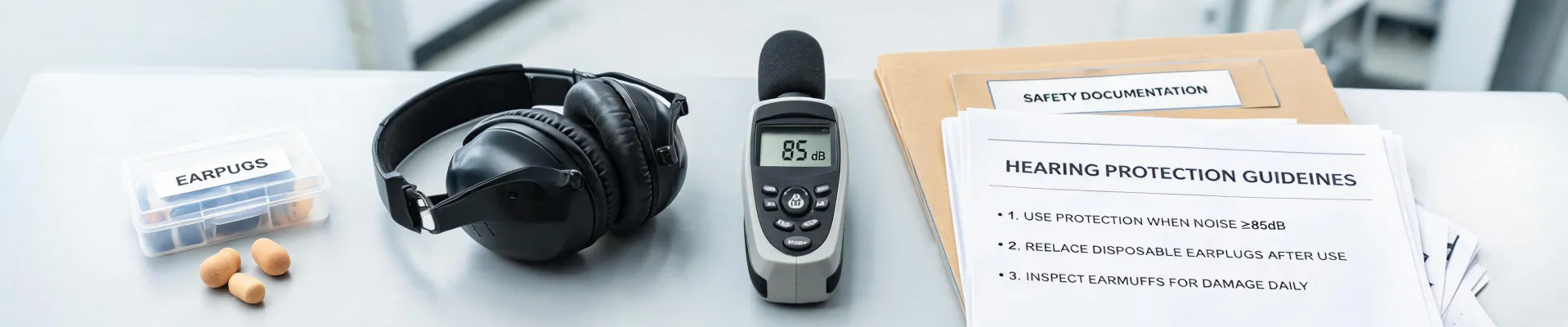
I know it's tempting to jump straight to pricing. Don't. Walk the floor with a sound level meter and record actual dB readings by zone. NIOSH recommends an 8-hour exposure limit of 85 dBA — anything above that requires hearing protection. But you also need to understand the character of the noise. Low-frequency hum from compressors needs different attenuation than high-frequency screech from cutting tools.
This step takes about 2 hours on a typical factory floor. It'll save you from the classic TCO mistake: paying NRR 33 pricing when NRR 25 would do, or worse — buying protection that doesn't meet compliance for your actual exposure levels.
Checkpoint: You have a zone-by-zone noise map with dB readings and estimated exposure times.
Step 2: Verify Real-World Attenuation — Don't Chase the Highest NRR
Every spec sheet lists an NRR (Noise Reduction Rating). That number comes from ANSI S3.19-1974 lab testing, which means a person fit the earplug perfectly in a quiet room. Field conditions are different. Real-world attenuation of foam earplugs can be 30-70% lower than the lab rating, depending on fit quality.
This is also where I'll answer a question I get constantly — the eargasm earplugs vs loop comparison. I see these consumer earplug brands everywhere now, marketed for concerts, focus, and sleep. My procurement answer is always the same: read the spec sheet. If a product doesn't carry an NRR rated under ANSI S3.19-1974, it's not industrial hearing protection. It might be a perfectly good consumer product. But it's not what you should order for an OSHA-regulated workplace.
Stick with products from manufacturers who publish their attenuation data — Howard Leight is the one I've standardized on because they document NRR for every SKU, and their earplug range covers disposables, reusables, and banded styles. That documentation matters when it's audit season.
Checkpoint: Every product on your shortlist has a verifiable NRR under ANSI standards — not just marketing language.
Step 3: Run a 2-Week Trial with Real Workers
Here's the story that changed my entire approach. In Q2 2024, I approved a $4,200 purchase order for Howard Leight Max foam earplugs — NRR 33, the highest rating available, at a unit price that looked unbeatable on paper. Three weeks later, the safety manager's report showed 60% of the boxes still sitting unopened in storage. Workers said they couldn't hear a thing, felt isolated from what was happening on the floor, and some admitted to wearing only one earplug as a workaround. That's not a compliance solution — it's an expensive liability.
The fix? A 2-week trial before any bulk commitment. Order samples from 3-4 product types — different earplugs (foam, pre-molded, banded) and at least one earmuff model. Distribute them to 10-15 workers across departments. Collect written feedback on comfort, communication, and whether they'd wear it for a full shift. It costs maybe $200 in samples and a few hours of coordination. Compared to a $4,200 order that 60% of workers reject, that's the cheapest insurance you'll ever buy.
Checkpoint: You have written feedback from at least 10 workers on at least 3 product types.
Step 4: Calculate True Per-Use Cost, Not Unit Price
This is the heart of total cost of ownership thinking. Let's break it down with real-world numbers I've seen across our orders:
- Disposable foam earplugs (e.g., Howard Leight Max, NRR 33): roughly $15-20 per box of 200 pairs. That's 8-10 cents per pair. At two pairs per worker per day, that's about $70-100 per worker per year. Seems unbeatable — until you factor in workers who don't wear them and the compliance risk that follows.
- Reusable earplugs: typically $0.50-2 per pair. With monthly replacement, that's roughly $12-24 per worker per year. But cleaning and hygiene add hidden costs, and loss rates run higher than manufacturers admit.
- Earmuffs: generally $15-80 per pair. A $25 pair of Howard Leight earmuffs with a 2-year service life gives you a per-use cost that beats most disposables — if your workforce treats them properly. Replacement ear cushions and headbands add maybe $5-10 per unit per year.
The math looks different in every facility. But the principle doesn't change: unit price is the least useful number on a quote. Add in distribution, inventory management, replacement rates, and — most importantly — compliance risk, and the "cheap" option frequently loses. I've built this into a simple TCO spreadsheet that I run before every PPE vendor comparison. It's saved us roughly 17% of our annual PPE budget since 2022.
Checkpoint: You've calculated per-worker-per-year cost for each option, including replacement and compliance factors.
Step 5: Consider Electronic Earmuffs When Workers Need to Hear
Here's a scenario that comes up more than people expect: a production floor that requires hearing protection but also requires workers to hear alarms, instructions, or approaching forklifts. Passive earmuffs cut everything equally. Workers respond by pulling one cup off an ear, instantly defeating the protection. And honestly, I don't blame them — in a loud environment without situational awareness, people feel unsafe.
This is where electronic earmuffs justify their premium. The Howard Leight Impact Sport electronic earmuffs amplify ambient sounds — including speech and backup alarms — while suppressing anything above 82 dB. Workers get protection and situational awareness. The Howard Leight Sync stereo earmuffs take that further by adding an audio input for music or radio communication. For monotonous packaging lines or long shifts, that small feature has a measurable effect on whether workers keep the muffs on all day.
From a TCO standpoint, the $50-80 premium over passive muffs is minor compared to the cost of a forklift near-miss or a missed emergency alarm. We trialed the Impact Sport muffs with our forklift operators in early 2024 — they became the standard for that zone within a month, and we've had zero complaints about isolation since.
Checkpoint: You've identified noise zones where communication or situational awareness matters, and trialed electronic muffs in at least one of them.
Step 6: Bundle Complementary PPE to Cut Procurement Overhead
Once you're ordering hearing protection, check what else workers need in those same zones. Every separate purchase order carries hidden administrative costs — processing, receiving, invoice matching, weekly delivery coordination. Consolidating orders saves money even when the products themselves aren't discounted.
In high-noise areas, two items I always check:
- Safety goggles: Before you finalize any goggle purchase, pull the spec drawing and verify the ANSI Z87.1+ marking is clearly called out. A lot of budget goggles on the market look the part but aren't impact-rated. If you're ordering for grinding or cutting zones, that certification is non-negotiable. The drawing will also show lens thickness and coverage angles — small details that matter when a worker is bending over a bench for 8 hours.
- Leather welding gloves: For any hot work near welding or metal processing, gauntlet-style leather welding gloves should be in the same order cycle. We standardize on them for our welding bays and buy them quarterly alongside hearing protection. It keeps the vendor relationship simple and gives us one shipping line instead of three.
Checkpoint: Your PPE order covers all required body areas for each zone — not just ears.
Step 7: Track Actual Consumption for 60-90 Days
You don't know if your procurement strategy worked until you measure real usage. Here are the three numbers I track after every PPE order:
- Issue rate: How many units were actually distributed to workers?
- Replacement rate: How fast are workers requesting replacements?
- Waste/returns: Any unopened boxes or product sitting in storage?
I didn't always do this. Everyone told me to track consumption before committing to bulk orders, and I didn't listen. The 2024 order I mentioned earlier came back with 60% of boxes untouched — that was the wake-up call. Now consumption data is a standard line item in my quarterly procurement reviews. The numbers don't lie, and they'll tell you whether to reorder the same mix or switch products entirely.
Checkpoint: You have consumption data at the 60-day mark, and a documented plan for adjusting the next order based on it.
Final Notes: What This Checklist Can't Do
I'm a procurement manager, not an audiologist or an industrial hygienist. If you're dealing with confirmed hearing loss cases, noise assessments that require professional equipment, or active OSHA citations, that's outside my territory. Get a qualified safety professional involved before making decisions.
My experience is also grounded in mid-sized industrial and manufacturing environments — roughly 200 orders across 6 years. If you're in construction, mining, or a sector with a very different noise profile, your product mix will probably differ from mine. The TCO framework transfers; the specific products may not.
But the core principle holds everywhere: the cheapest hearing protection is the one that gets worn. If you build that into every purchasing decision, the numbers and the safety record will both come out right.

Maeve Callahan
Maeve Callahan is a head-protection analyst covering Type I and Type II hard hats, climbing-style safety helmets, bump caps, chin straps, suspensions, liners, and face-shield carriers. She applies ANSI Z89.1, EN 397, and EN 12492 criteria while comparing impact attenuation, penetration resistance, lateral deformation, electrical class, retention strength, field of vision, mass, fit range, and temperature conditioning. Her guides help EHS teams, contractors, utilities, and buyers select helmet systems for overhead hazards, work at height, electrical exposure, accessory compatibility, and worker acceptance.