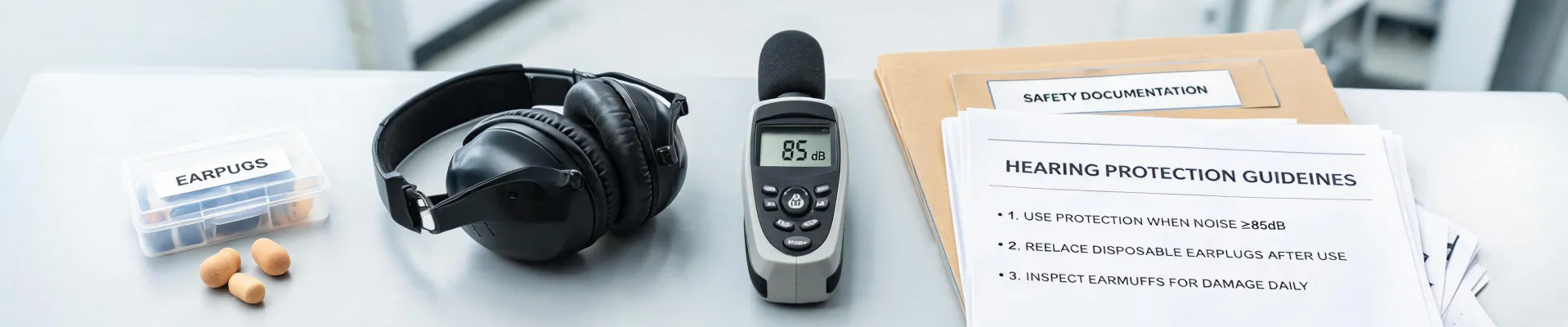
-
Step 1: Verify the Product Specs Against Your Hazard
-
Step 2: Don't Assume One Size Fits All (Check the Fit First)
-
Step 3: Always Double-Check the SKU and Packaging
-
Step 4: Check the Regulatory Compliance (Especially for 'Dog Fence' Type Enclosures)
-
Step 5: Don't Buy Without a Return or Exchange Policy (Unless It's Stock)
-
Final Notes on This Checklist
When I first started handling safety equipment orders, I assumed the lowest quote was always the best choice. Three budget overruns, one compliance nightmare, and a lot of wasted inventory later, I learned about total cost of ownership.
I'm a procurement coordinator who's been handling PPE orders for about six years. I've personally made (and documented) five major mistakes, totaling roughly $8,200 in wasted budget. Now I maintain our team's checklist to prevent others from repeating my errors.
This checklist is for anyone who buys hearing protection, coveralls, or safety gear in any volume. It's for the person who's not a safety expert but has to make sure the order is right. Here are the five steps I now follow without fail.
Step 1: Verify the Product Specs Against Your Hazard
My first big mistake was in 2018. We needed earplugs for a new shop floor. I saw the price on Howard Leight Laser Lite earplugs and thought, 'Great deal.' I ordered 500 boxes.
The problem? Our noise levels averaged 95 dB. The standard Laser Lite has an NRR of 32, which is good, but I didn't check if they were the right fit for our workers' ear canals. Turns out, a lot of our staff have smaller ear canals. The plugs didn't fit snugly, which reduced the effective protection. I still kick myself for not checking the NRR rating against our actual noise survey data.
What I do now: Before I even look at the price, I pull the latest noise monitoring report (as of our Q3 2024 audit). I match the required protection level to the product's NRR. For Howard Leight, I check if we need the Max Lite (NRR 33) for the loudest areas or the Laser Lite for general use. I also verify the fit type—foam, pre-molded, or banded—based on worker feedback.
Step 2: Don't Assume One Size Fits All (Check the Fit First)
This seems obvious, but I ignored it. We ordered disposable coveralls for a cleanup crew. I checked the size chart, picked 'Medium,' and ordered 100. When they arrived, they were too tight in the shoulders for half the team. We had to reorder, which cost us a 3-day delay on the project.
So glad I finally learned this lesson. Almost made the same mistake with Howard Leight earplugs again. We now get sample packs. I order the Howard Leight Max Lite and Laser Lite sample kits. I set up a fit-testing station for a day. The safety manager and I watch the team insert them. If they can't get a good seal, that product is off the list.
Checklist item: 'Did we order samples and verify fit for at least 10% of the user group before placing the bulk order?' If not, stop.
Step 3: Always Double-Check the SKU and Packaging
This one cost me $450. It was a straightforward order for howard leight max lite earplugs. I checked the spec sheet, approved the PO, and we processed it. The delivery was huge. We opened a box expecting the standard 200-pair box of uncorded earplugs.
We got the corded version. The SKU was one digit off. 'MAX-100-UNC' vs 'MAX-100-COR'. The corded ones aren't suitable for all areas because of entanglement risks. Straight to the trash. $450 wasted plus a week of delays while we expedited the correct stock.
My trick: I now have a master spreadsheet with the exact SKUs we use. Before I submit any PO, I copy the SKU from the spreadsheet and paste it into the order form. I do not type it manually. Ever.
Step 4: Check the Regulatory Compliance (Especially for 'Dog Fence' Type Enclosures)
This is a weird one. We bought some portable barrier systems—basically movable fencing for temporary hazard zones. The vendor called it a 'dog fence' in their catalog because it's the same material used for pet enclosures. We needed it to restrict access to a welding area.
Under OSHA's Guarding Floor and Wall Openings and Holes standard (29 CFR 1910.23), the fence needs to be a certain height and strength. The cheap 'dog fence' we ordered was only 36 inches high and not designed for industrial loads. An inspector flagged it immediately.
Dodged a bullet that it was caught before someone got hurt. Now my checklist has a line: 'Is this item actually rated for the specific OSHA/ISO standard required for our application?'
Step 5: Don't Buy Without a Return or Exchange Policy (Unless It's Stock)
Another hard lesson. I ordered a small lot of howard leight max lite earplugs reviews I'd read on a forum suggested these were the best. They arrived, and a key team member had an allergic reaction to the foam. We tried to return them. The supplier said, 'Safety products, sanitary goods, no returns.'
Had 2 hours to decide before a deadline. Normally I'd negotiate the terms first, but there was no time. Went with our usual vendor based on trust alone. In hindsight, I should have pushed back. But with pressure from the plant manager, I made the call with incomplete information.
Now: I always ask for a 15-day inspection period on any new product or first-time order. Most good suppliers will offer it if you ask.
Final Notes on This Checklist
This works for about 80% of standard PPE orders—hearing protection, coveralls, hard hats, basic gloves. It's not designed for full respirator programs or complex fall protection systems where you need a certified specialist to design the system.
If you're dealing with:
- Regulatory changes (like a new standard for disposable coveralls), you still need to verify this checklist against the latest guidance.
- Very small orders (under $100), some of these steps are overkill. Just check the SKU.
- Life-critical items (like fall protection for a 20-foot drop), don't use this list. Hire a professional.
The bottom line: most procurement mistakes in PPE come from skipping the verification steps. A simple pre-order checklist—even just these five items—can save you a lot of money and a lot of headaches. I've used this list for the last 18 months and caught 47 potential errors. That's a lot of money and embarrassment saved.
Maeve Callahan
Maeve Callahan is a head-protection analyst covering Type I and Type II hard hats, climbing-style safety helmets, bump caps, chin straps, suspensions, liners, and face-shield carriers. She applies ANSI Z89.1, EN 397, and EN 12492 criteria while comparing impact attenuation, penetration resistance, lateral deformation, electrical class, retention strength, field of vision, mass, fit range, and temperature conditioning. Her guides help EHS teams, contractors, utilities, and buyers select helmet systems for overhead hazards, work at height, electrical exposure, accessory compatibility, and worker acceptance.