-
The day I stopped buying earplugs by price
-
Why I was comparing Howard Leight earplugs at all
-
Why NRR 33 wasn't the only number that mattered
-
Quiet earplugs vs MAX earplugs: more than a spec sheet
-
The surprise wasn't the price difference
-
Safety shoes, a black metal fence, and the image problem
-
The total cost of a hearing protection program
-
What I actually ordered and what happened
-
What I'd tell another procurement manager
-
One search term I can't help with
The day I stopped buying earplugs by price
Last spring, I was standing by the black metal fence that separates our compressor room from the main walkway. In one hand I had a box of Howard Leight Quiet earplugs. In the other, a box of Howard Leight MAX earplugs with NRR 33 printed across the side. The price difference between the two was less than a nickel a pair.
I know that doesn't sound like a decision that should keep anyone up at night. But I've been the procurement manager for a 90-person metal fabrication shop for six years. I track every invoice in our cost system. And I learned a long time ago that the four-cent gap on the shelf can turn into a much bigger cost on the production floor.
Why I was comparing Howard Leight earplugs at all
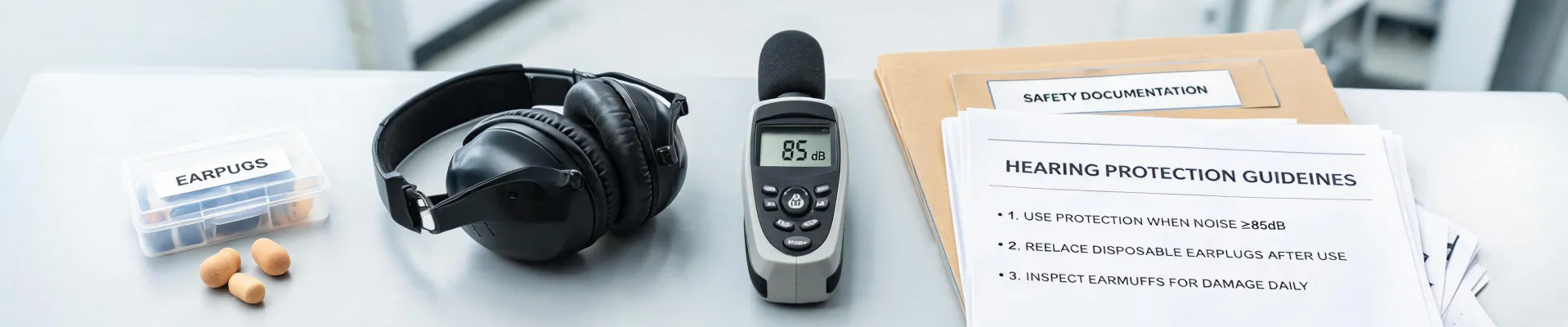
We had to re-source our hearing protection after our old supplier changed its distribution model. Around the same time, our safety coordinator completed a noise survey and found that two areas of the shop were running above an 8-hour average of 85 dBA. Under OSHA's hearing conservation standard (29 CFR 1910.95), that triggers a formal hearing conservation program. We needed earplugs that people would actually wear, not just a box that looked good at the tool crib.
So I did what I always do when a budget line gets complicated: I opened a spreadsheet and started comparing product pages.
Why NRR 33 wasn't the only number that mattered
Everything I'd read about hearing protection said the same thing: pick the highest NRR and move on. The conventional wisdom is that the Noise Reduction Rating is the whole story. My experience with 90 employees suggests otherwise.
NRR is a lab measurement. It's required on hearing protector labels under EPA regulations (40 CFR Part 211), and it gives you a starting point for comparing products. The Howard Leight MAX earplugs NRR 33 product page is about as clear as a product page gets: 33 dB, single-use foam, tapered shape for easier fitting. But that number assumes a perfect fit from a person who actually read the insertion instructions.
Our production floor doesn't run on perfect-fit assumptions. People are in a hurry. They take gloves off and on. Some workers roll an earplug halfway and call it good. The best NRR in the world doesn't help if the earplug is sitting on a bench.
Quiet earplugs vs MAX earplugs: more than a spec sheet
The Howard Leight Quiet earplugs are a different animal. They're reusable, corded, and easy to hang around a neck when someone steps from the office into a noisy aisle for a few minutes. They aren't the right tool for eight hours next to a compressor. But they are the right tool for a supervisor who needs intermittent protection without taking a foam plug in and out all day.
The MAX earplugs, on the other hand, are the workhorse for high-noise zones. They're disposable, so there's no question about how long they've been used. The NRR 33 rating gave us the protection ceiling we needed. What sold me was the way the product page explained fit and the way the foam expands after insertion. That alone made training easier.
The surprise wasn't the price difference
Here's where I underestimated the process. The surprise wasn't the unit price. It was the labor cost of training.
I ran a 20-minute toolbox talk on how to roll, insert, and hold foam earplugs properly. Twenty minutes doesn't sound like much. Multiply it by 80 employees in the high-noise zones, plus the new-hire refreshers we run every quarter, and the real cost of switching products wasn't the 4 cents per pair. It was the floor time, the supervisor follow-ups, and the reminders to people who still tried to skip them.
From the outside, all disposable foam earplugs look the same. The reality is that the ones people will tolerate are the ones they'll wear consistently. The MAX earplugs were comfortable enough that the crew didn't complain. That's not a line on a spec sheet, but it's a real cost-saving feature.
Safety shoes, a black metal fence, and the image problem
The same logic pushed into the rest of our PPE order. I added safety shoes to that quarterly order because a few soles were cracked and nobody should be walking through a metal shop with wet socks. If I bought the lowest-priced pair, they would pass the basic standard. But I also knew they would look run-down within a month, and in a facility where customers walk the floor, that matters.
The black metal fence around the compressor bay isn't decorative. It keeps people away from a dangerous machine. But it's also one of the first things a visitor sees. A scuffed, dented fence tells people this is a place where safety is a poster. A clean, well-maintained fence says the opposite.
This is where quality and purchasing meet. I used to think brand image belonged to marketing. Then a potential client walked through the shop, asked about our hearing protection program, and noticed our old noise-zone signage. We reprinted the signs using our brand color matched to the Pantone Matching System and output them at 300 DPI at final size, which is standard for commercial print. It felt like overkill. The same client later said our facility felt more professional than another shop they'd visited. I don't think that was about signage alone. It was the combination: the fence, the safety shoes, earplugs worn by everyone in the high-noise area.
The total cost of a hearing protection program
Here's the framework I used, and I wish I had written it down years ago: total cost equals unit price plus training time plus replacement rate plus wasted product plus enforcement.
- Unit price: The MAX earplugs cost more per pair than generic foam plugs. We paid roughly $20 for a 200-pair box from a distributor in early 2025. Verify current pricing before you order; it moves.
- Training time: One 20-minute session, repeated for new hires and for anyone who suddenly starts avoiding the noise zones.
- Replacement rate: Corded earplugs will disappear. So will loose foam plugs. Budget for it.
- Enforcement: If people won't wear a hearing protector, the NRR number is fictional. The enforcer is visibility.
When I put all of this into the spreadsheet, the Howard Leight MAX earplugs were not the cheapest option. They were the most cost-effective option for our high-noise zones. That's a distinction I can defend to a CFO.
What I actually ordered and what happened
At the end of the review, I ordered Howard Leight MAX earplugs with NRR 33 for the two high-noise departments. I ordered Howard Leight Quiet earplugs for the office-and-floor staff who need intermittent protection. I replaced the cracked safety shoes. And I had the compressor fence repainted black as part of the same safety walk-through.
Three months later, our monthly earplug usage went down because more of what we bought was actually being worn. Noise complaints went down. And on the next client walk-through, nobody had to be told to put earplugs in.
What I'd tell another procurement manager
Don't let a product page make the decision for you. Use the product page to understand what the brand is promising: the NRR 33, the shape, the packaging, the compliance data. Then match it to your own noise map, your own employees, and your own spreadsheet.
To be fair, the cheapest earplug might work in a low-noise shop with a stable crew. That's not been my experience with our floor. Our production changes, noise levels change, and the last thing I want is a program that looks good on paper and falls apart at the moment someone walks past the black metal fence.
I'm not 100% sure our numbers apply to every facility. They're specific to a 90-person metal fabrication shop. But I'd bet the principle holds: the highest-rated protector only works if people wear it, and the total cost of a PPE program is always bigger than the line item on the purchase order.
One search term I can't help with
One last thing: someone found this article by searching 'can you bring pepper spray to school,' and I can't answer that one. It's outside my procurement spreadsheets and above my pay grade.
But if you're here because you were looking at Howard Leight Quiet earplugs or the Howard Leight MAX earplugs NRR 33 product page, I can tell you this much: buy the ones your people will actually wear, keep the training records, and don't let a four-cent price gap be the reason your safety program looks weak.
Prices and regulations are for general reference only. Verify current rates and requirements before purchasing.

Maeve Callahan
Maeve Callahan is a head-protection analyst covering Type I and Type II hard hats, climbing-style safety helmets, bump caps, chin straps, suspensions, liners, and face-shield carriers. She applies ANSI Z89.1, EN 397, and EN 12492 criteria while comparing impact attenuation, penetration resistance, lateral deformation, electrical class, retention strength, field of vision, mass, fit range, and temperature conditioning. Her guides help EHS teams, contractors, utilities, and buyers select helmet systems for overhead hazards, work at height, electrical exposure, accessory compatibility, and worker acceptance.